Epoxy flooring fumes and air quality: staying safe during installation
By Adam · Updated 2026-06-24
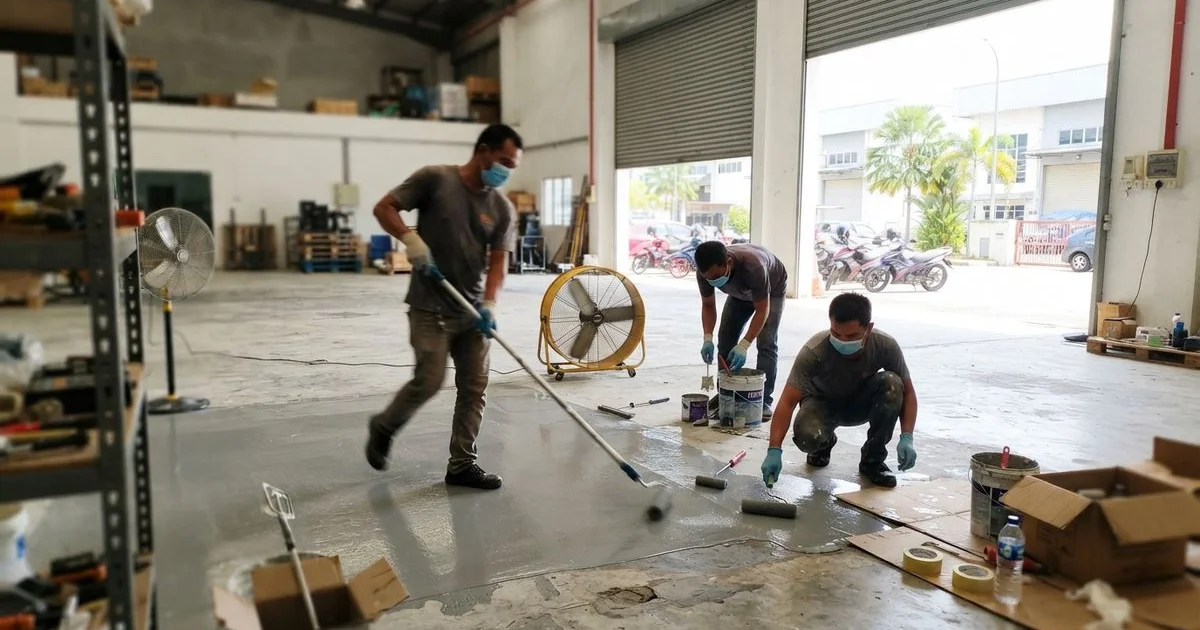
This is general safety information, not medical advice. If you have a specific health condition or sensitivity, it’s worth discussing precautions with a doctor before being present during an epoxy installation.
Epoxy coatings give off a strong chemical smell during application, and that smell isn’t just unpleasant, it’s a sign of volatile organic compounds being released into the air. For a garage or industrial floor that’s normally unoccupied during the day, this is a manageable, temporary issue. For spaces closer to living areas, it’s worth planning around properly.

When fumes are at their strongest
Fumes peak during mixing and application, and stay noticeable through the first one to two days of curing. After that, the smell fades quickly for most systems, though a much lower level of off-gassing can continue for longer in a space with poor airflow. This is why ventilation matters not just on install day, but for several days afterward too.
Keeping the space safe during and after installation
- Ventilate as much as possible. Open doors and windows where safe to do so, and use fans to keep air moving through the space during application and the first days of cure.
- Close the space off from living areas. If the epoxy area connects directly to the rest of the home, seal gaps under doors and keep that connecting door shut during application.
- Avoid the space during application. Even in a garage, staying out of the room while the contractor is actively coating reduces direct exposure.
- Watch for symptoms. Headaches, dizziness, or throat irritation are signs the space needs more ventilation or that you should step away until air clears.
- Ask about low-VOC systems. If air quality is a bigger concern for your household, ask your contractor whether a lower-VOC formulation is an option for the job.
Who should take extra care
Pregnant women, young children, older adults, and anyone with asthma or a respiratory condition are more sensitive to VOC exposure and should avoid the space during application and initial cure. If your epoxy job is in a garage attached to the home, consider whether household members in these groups can stay elsewhere, even for a day or two, while the strongest fumes clear.
Timing the job around your household
If you have flexibility, scheduling an epoxy job for a period when the affected space can stay closed off and unused for a few extra days makes the whole process easier to manage. Weekday installs, when household members are often out during the day, can also reduce direct exposure compared with a weekend job where everyone is home.
If the epoxy area is a standalone structure, a detached garage or a separate industrial unit, air quality concerns are naturally lower since there’s more separation from daily living spaces. It’s mainly attached garages, basement-level spaces, and commercial units with limited airflow where extra planning pays off.
After the job is done
Once the topcoat has cured, ongoing off-gassing drops to a low level for most systems, but it’s still sensible to keep the space well ventilated for the first week or two of regular use, particularly before parking a vehicle inside or running equipment that generates its own heat, since warmth can temporarily increase off-gassing. If a strong chemical smell persists well beyond the timeframe your contractor described, it’s worth raising with them rather than assuming it will resolve on its own.
What a responsible contractor does
A contractor who takes this seriously will talk through ventilation before starting, not just show up and start coating. Ask what system they’re using, roughly how long the smell typically lasts for that product, and whether they recommend keeping the space closed off from the rest of the house during application. If a contractor brushes off the question or seems unfamiliar with basic ventilation practice, that’s worth factoring into your decision.
Browsing epoxy and industrial flooring contractors who are upfront about this kind of detail in their listings or reviews is a reasonable way to narrow down who to call. Our scoring method on this directory explains how contractor listings are assessed more broadly.
For the coating process itself, see how epoxy flooring is installed, and for typical pricing, what epoxy flooring costs in Malaysia breaks down the ranges by system.
FAQ
- How long do epoxy flooring fumes last?
- Fumes are strongest during application and the first day or two of curing, tapering off significantly after that. Full off-gassing can continue at a much lower level for longer, especially in a poorly ventilated space, so ventilation matters beyond just the first day.
- Is it safe to be in the house while epoxy flooring is being installed?
- For a small, well-ventilated area like a single garage, many people stay in the home, though it's sensible to keep the space closed off and ventilated, and to avoid the room itself until fumes have cleared. For larger jobs or anyone sensitive to strong smells, temporarily staying elsewhere during application and initial cure is a reasonable precaution.
- Do low-VOC or water-based epoxy options exist?
- Yes, some epoxy systems are formulated to reduce volatile organic compound content compared with standard solvent-based systems. If air quality is a particular concern, ask your contractor directly whether a lower-VOC option is available for your job.
- Who should be extra cautious around epoxy fumes?
- Pregnant women, young children, older adults, and anyone with asthma or respiratory sensitivity should avoid the space during application and initial cure, and ideally stay elsewhere until ventilation has had time to clear the strongest fumes.