DIY flooring installation vs hiring a professional in Klang Valley
By Adam · Updated 2026-06-15
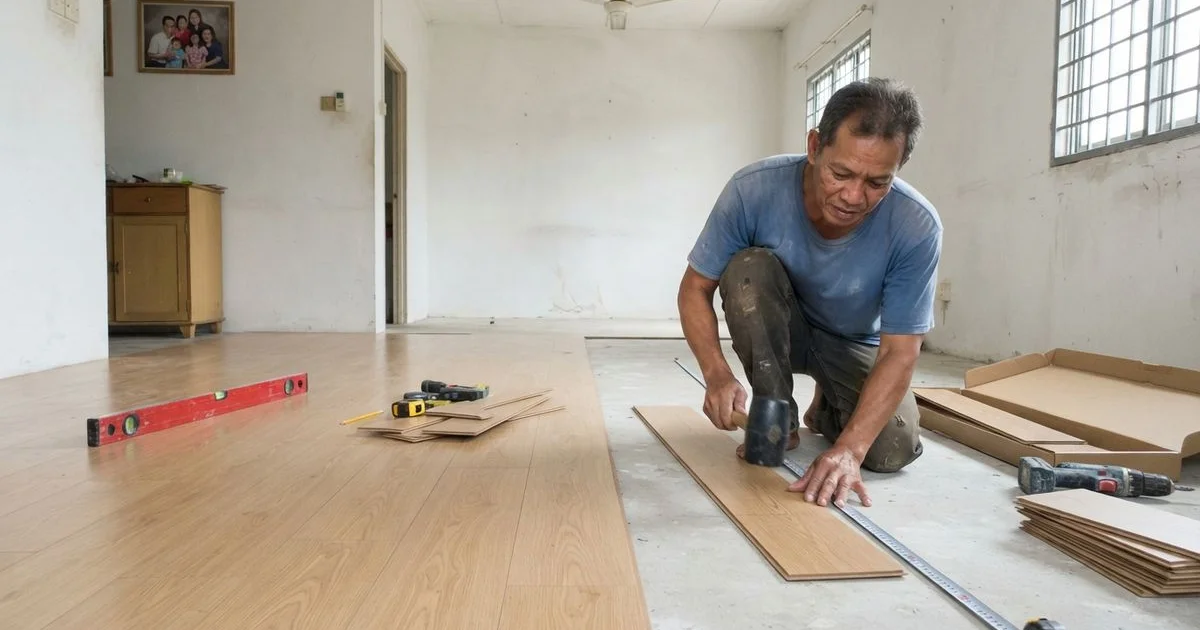
The DIY-or-hire question comes up on almost every flooring project, and the honest answer depends heavily on the material. Some flooring types are genuinely forgiving of a first-timer’s mistakes. Others punish a small error with a redo that costs more than hiring a professional would have in the first place.
Where DIY realistically works
Click-together SPC and vinyl plank are the most DIY-friendly flooring materials on the market. No adhesive is needed for most rigid-core products, cuts can be made with basic tools, and mistakes in a corner or under furniture are easy to hide. Laminate sits in a similar category, though it’s slightly less forgiving of subfloor unevenness.
Carpet tiles are also reasonably approachable for a DIY attempt, particularly in a small room, since they’re lightweight and don’t require the precision that hard flooring materials do.
Where hiring a professional makes more sense
| Material | DIY difficulty | Why |
|---|---|---|
| SPC / vinyl plank | Low | Click-together, forgiving of small errors |
| Laminate | Low-medium | Similar to vinyl, less forgiving of an uneven subfloor |
| Carpet tiles | Low | Lightweight, easy to reposition |
| Parquet / engineered timber | High | Needs acclimatisation, precise fitting, moisture barrier |
| Tile / marble | High | Needs exact levelling, grout work, tile cutting |
| Epoxy | High | Surface prep, chemical mixing, ventilation and timing |
Tile, marble, parquet, and epoxy all involve either wet trades, precise levelling, or handling materials that behave unpredictably if mixed or applied slightly wrong. A tile laid unevenly can crack under weight later. Epoxy applied over a poorly prepared or damp slab can bubble or peel within months. These aren’t mistakes you find out about immediately, which makes them expensive to fix after the fact, since by the time the problem shows up the material and labour have already been spent once.
The real cost comparison
DIY saves on labour, which is often 40 to 60% of a job’s total cost depending on the material. But that saving assumes the job goes right the first time. Wasted material from cutting errors, tool rental, and the cost of hiring a professional anyway to fix or redo a failed DIY attempt can eat into or erase the saving, particularly on anything beyond simple click-together flooring.
A reasonable middle ground for many homeowners is splitting the job: handle furniture removal, old floor pull-up, and general room prep yourself, then bring in a professional for the actual installation. This trims labour cost without taking on the parts of the job where a mistake is hardest to undo.
What you give up by going DIY
Beyond the labour itself, hiring a professional usually comes with a workmanship warranty and someone to call if a plank lifts or a seam opens up a few months later. DIY work carries none of that. If something goes wrong, the fix, and the cost of that fix, falls entirely on you. For a low-stakes room this is a manageable risk. For a main living area or a material like tile where a fault is disruptive and expensive to correct, that missing safety net is worth weighing against the money saved.
It’s also worth being honest about time. A professional crew brings the right tools and has done the job enough times to move efficiently. A first attempt at DIY flooring often takes several times longer than a crew would need, which matters if the room needs to be back in use quickly.
How to decide
Ask yourself three questions before committing to DIY: is the material forgiving of small errors, is the room a simple shape without a lot of cuts, and can you tolerate the room being unusable for longer than a professional crew would need. If the answer to any of these is no, it’s usually worth getting a couple of flooring contractor quotes before buying materials, even if you end up doing some of the prep work yourself.
Our scoring method explains how listings on this directory are ranked, which is a useful place to start if you decide hiring a professional is the safer call.
FAQ
- Is SPC or vinyl flooring realistic to install myself?
- For a small, simple room with an already-flat subfloor, many people install click-together SPC or vinyl themselves. Larger areas, rooms with lots of cuts and corners, or a subfloor that needs levelling first are where DIY starts to get harder to pull off cleanly.
- Should I ever attempt tile, marble, or epoxy flooring myself?
- These are generally not good DIY candidates. Tile and marble need precise levelling and grouting to avoid cracking or uneven surfaces, and epoxy involves surface prep and chemical handling that's easy to get wrong in ways that only show up months later.
- How much money does DIY actually save?
- It saves on labour cost, but not always as much as expected once you factor in tool rental, material wasted on cutting mistakes, and the risk of a redo if something goes wrong. For simple vinyl or laminate jobs the saving is usually real; for complex materials it often narrows or disappears.
- What's the middle ground between full DIY and hiring a full contractor?
- Some people handle furniture removal, old floor pulling and room prep themselves, then hire a contractor just for the installation itself, which can reduce labour cost without taking on the parts of the job that are hardest to get right.